 AJS Furniture
Melamine cabinets can look crisp and modern, but their smooth, sealed faces make paint adhesion harder than it is on bare wood. Can I paint over melamine kitchen cabinets? Yes, if the surface is sound and the preparation is thorough. Clean away grease around handles, lightly abrade the glossy finish, and use a bonding primer made for slick surfaces. Skipping a step may save an hour, then cost you a peeling door.
The Houzz 2024 U.S. Kitchen Trends Study reports a median spend of $55,000 for major kitchen remodels. That figure helps explain why refreshing existing cabinets can be attractive, though painted melamine is not identical to factory-finished cabinetry. Bob Vila’s published guidance on painting laminate cabinets emphasizes proper preparation; applied to melamine, the practical lesson is to clean, scuff, prime, and test before committing. This is a paraphrase, not a direct quotation.
Test the full process on the inside of one door. Let each coat dry for the time stated on its label, then check the finish near an edge and handle. A small test patch can reveal poor adhesion before every cabinet is coated. For China-made melamine kitchen cabinets, inspect seams, chips, and lifting edges first; paint cannot repair a failing substrate. Results depend on the cabinet’s condition, primer, paint system, and careful curing. It may work beautifully. It may still show brush marks.
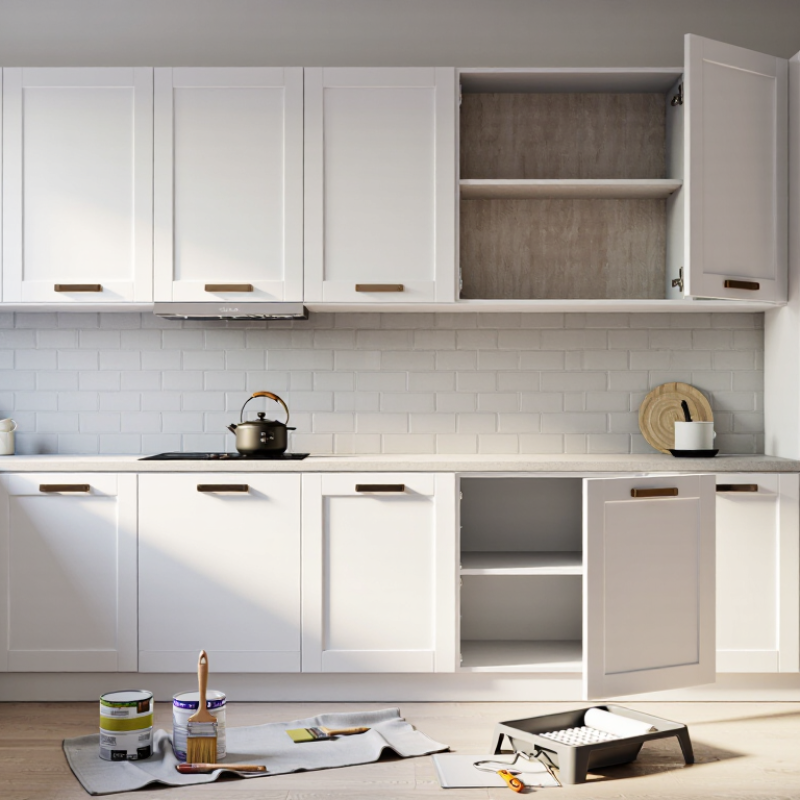
Melamine kitchen cabinets are typically made from particleboard or medium-density fiberboard covered with a thin decorative paper layer. The paper is saturated with melamine resin, then bonded to the panel under heat and pressure. This creates a hard, even surface with a printed color or wood pattern. The core provides structure; the outer layer provides the visible finish.
The finished surface is smooth and relatively nonporous, so it does not absorb paint like bare wood. That slickness can make paint peel if the cabinet is not prepared properly. Edges, corners, and areas around handles may also wear differently from flat panels. Check for swelling or loose laminate before painting. Paint may not fix those problems. A small test area is worth the extra time, even when the surface looks uniform.
Tips: Clean away grease, lightly abrade the finish, and remove dust before applying a bonding primer made for laminate surfaces. Use thin, even coats, and allow each coat to dry fully. Start on an inconspicuous door. Results depend on the cabinet’s condition and careful preparation.
| Topic | What It Means | Practical Detail |
|---|---|---|
| What melamine cabinet doors are | Cabinet panels made from a wood-based substrate with a hard, decorative resin-treated surface layer. | The substrate is commonly particleboard or MDF; construction varies by product. |
| How the surface is made | Decorative paper is impregnated with melamine resin and bonded to a panel under heat and pressure. | This process is commonly known as thermal-fused melamine or thermally fused laminate (TFL). |
| Surface characteristics | The finished face is generally smooth, nonporous, and resistant to everyday stains and abrasion. | It is not waterproof at every joint or edge; prolonged moisture can damage an exposed or poorly sealed substrate. |
| Can melamine cabinets be painted? | Yes, but paint does not readily bond to the original slick surface without careful preparation. | The result depends on surface condition, preparation, primer compatibility, application, and curing. |
| Before painting | Remove grease and residue, rinse if required by the cleaner, and let the surface dry fully. | Repair loose or peeling areas first. Do not paint over a failing surface and expect a durable finish. |
| Creating a paint-ready surface | Lightly abrade the face to reduce its sheen, then remove all sanding dust. | Avoid sanding through the decorative layer; follow the coating manufacturer’s surface-preparation instructions. |
| Primer and topcoat | Use a bonding primer specified for slick or laminate surfaces, followed by a compatible cabinet coating. | Observe the product’s application, recoat, and curing instructions; test the system on an inconspicuous area. |
| Edges and joints | Panel edges may be covered with edge banding, while cuts, seams, and damaged spots can expose the substrate. | Check these areas carefully and address damage or exposed material before painting. |
| Care after painting | Allow the coating to cure as directed before reinstalling doors or cleaning them. | Use gentle cleaning methods and avoid abrasive pads that may scratch the new finish. |
| Melamine versus high-pressure laminate | Both are resin-based decorative surfaces, but they are made using different construction processes. | Identify the actual surface before choosing preparation and coatings; product terminology can vary. |
They usually have a particleboard or medium-density fiberboard core, covered with decorative paper bonded using melamine resin. The core provides structure; the outer layer gives the cabinet its color or pattern.
Yes, if the surface is in sound condition and prepared carefully. Its smooth coating gives ordinary paint little grip. Test first.
Choose a bonding primer labeled for melamine, laminate, or other slick surfaces. Follow its drying instructions. I would not skip the test patch, even when it feels like extra waiting.
Remove doors and hardware, then clean away grease, especially around handles. Rinse and let everything dry fully. Lightly scuff with 180- to 220-grit sandpaper, then remove the dust.
Use a small foam roller on flat panels and an angled synthetic brush around edges and corners. Avoid loading the roller heavily. Thick paint can leave ridges.
Apply thin, even coats of primer and paint, allowing each to dry as directed. Thin coats help. A surface that feels dry may still be soft underneath.
Not reliably. Deep chips and swollen particleboard may remain visible, and paint cannot repair loose laminate. Check the edges and corners before starting.
Give the coating several days to harden before regular use; full curing may take longer. Wipe spills promptly with a soft cloth and mild soap, then dry the area. Avoid abrasive pads and standing water near seams.
Melamine kitchen cabinets have a smooth, durable surface made by bonding a decorative resin layer to a core material. That nonporous finish can make ordinary paint difficult to stick, so the key question, “Can I paint over melamine kitchen cabinets,” depends largely on careful preparation. Remove cabinet doors and hardware, clean away grease and residue, then lightly sand the surface to reduce its sheen without damaging the coating. Wipe off all dust and apply a primer formulated to bond with slick surfaces.
Once the primer has dried as directed, use a durable cabinet paint and suitable brushes or a small roller to apply thin, even coats. Allow each coat to dry fully, and add another if needed for smooth, consistent coverage. Let the finish cure before reinstalling hardware or returning items to the cabinets. Gentle cleaning and avoiding harsh abrasives will help protect the painted surface and keep the cabinets looking fresh.
